Showing posts with label electronics component. Show all posts

Tuesday, February 19, 2013

RGB LED Fader with PIC12F675 using software PWM - part 1

Check the video below.

Details to follow soon...

Monday, February 18, 2013

DIY T10 LED light for Car (used on Hyundai Santro)

LED light is very popular for cars these days. There are different types of bulb sockets and wattage/lumens (light intensity) for different purpose. The common bulbs used are for dashboard/side turn indicators called T10 wedge bulbsFor front and rear turn indicators and stop light BA15S and BA 15D (Bayonet socket with single or double contact) bulbs are used. You can try eBay.in to check some deals available.

T10 wedge bulb being commonly used for motor cycles also, I decided to make one using a tri chip 5050 smd LED (3 LEDs in one package) of white light. You would also need a 100 ohm resistor to limit the current and voltage for the LED and a general purpose board or copper clad board piece. For the LED I have used smd 1206 resistances. I also used a IN4148 diode for ensuring right polarity. 


Finished product is a copper clad board with resistor and diode soldered and LED on the top side,
  

As visible on a Hyundai Santro car's dashboard when illuminated in dark.

Also used this t10 bulb for Hyundai Santro's pilot light.

Sunday, February 17, 2013

In Circuit Programming connection for PIC Microcontrollers

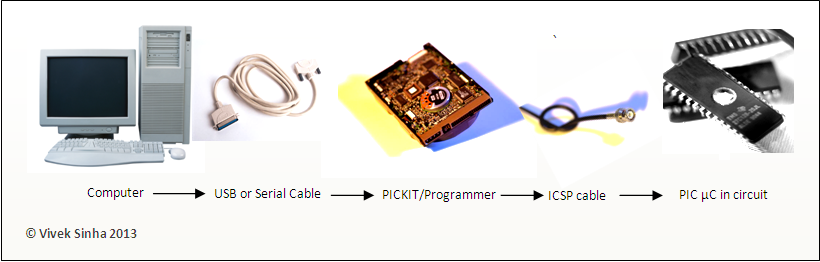
For the PIC Microcontrollers to function as per the program, the program needs to be loaded to its EEPROM. ICSP is the method which would enable the programming of the MC while in circuit, i.e., you do not have to remove the microcontroller from the circuit board to program it.

To program a microcontroller you would require a programmer (e.g., PICKIT2 or similar). It is a piece of hardware which can be connected to a computer with PICKIT2 programmer software or similar software through a serial or USB connection. The programmer has ICSP header pins which needs to be connected to PIC in the circuit which has to be programmed.


Following is the ICSP connection details to connect to different PIC microcontrollers.

Once the ICSP headers are connected to the PIC in circuit you can Write the program from the programmer software to the PIC.

More on programming the PIC in later posts...

Monday, July 30, 2012

Electronics and Robotics component online shopping in India

The growth of numerous Internet based shopping portals like Flipkart, Infibeam, Jabong, Myntra etc, made me wonder if was also possible to buy electronics components online in India. The reason to go online is due to the fact that the main electronics market is very far from the place I live and components or parts as per my requirement may not be available locally.

There are some global shopping portals already available, like Digikey, Mouser, RS Components, Element 14, but ordering from them would be an expensive affair due to high shipping cost to India. This made me start with a Google search of online electronics components sellers. The first page itself bought some useful information, however, there were 2 blog posts which I found informative - Manish Chiniwalar and Achu's TechBlog - both contain almost the same information. In the past couple of months I used a few of these portals to buy components and boards for my requirements.


One of the things that I learnt while browsing these lists and using these online shops was that there was no review of these portals available. For a new person who had no  experience other than buying books, clothes, kid's shoes or mobiles online, the experience can be very different. So I thought to put together my experience of these portals.


URLs: 1. Nex-Robotics, 2. Probots, 3. OnlineTPS and 4. Sunrom

Another website with a good inventory seems to be Hobby2Go, however the prices are on the higher side and I have had no experience of dealing with them yet. Ebay.in is another source from where you can find some deals at times (notice the 16x2 char LCD I bought from ebay).

Hope this post would help you in shopping for components online and you can share your experience in the comments.

© Vivek Sinha, 2012